 Express Products
Local authorities can benefit from a smoother, simpler, safer, and more efficient way to collect food waste.
Food waste, by its very nature, is difficult for local authorities and councils to collect. Unlike lighter materials such as paper, plastic or even metal, food waste is denser and heavier than most recyclables. Not only this, but organic material is more easily compressed and compacted together than other types of waste, resulting in even more weight concentrated in the same volume. This creates problems for waste collectors and their vehicles, with the heavier burden requiring mechanical lifting for any large-scale collection efforts.
Then there is the shorter ‘shelf life’ of food waste to consider. While plastic or card can be left in recycling bins for longer, food waste will quickly rot, causing unpleasant smells and attracting rodents. This is particularly problematic for busy streets and apartment blocks, where large quantities of food waste can quickly build up and contribute to environmental health issues. To resolve this, food waste often needs to be collected more regularly than other types of waste, causing logistical headaches and tying up important resources.
As evolving legislation and soaring landfill costs make the collection of food waste mandatory for councils, the need for a faster, more efficient way to deal with food waste has become apparent. A potential solution must 1) be able to navigate the tight confines of city streets, 2) allow easy operation to reduce manual strain on waste collectors, and 3) enable quick emptying to make frequent collections more efficient for local authorities.
Why Is Food Waste Collection Now Mandatory?
As part of the new Simpler Recycling legislation, from the 1st April 2026 all local authorities must collect waste and recycling in the same way. This requires 4 mandatory waste streams—general waste, dry mixed recyclables, paper and cardboard, and food waste—to be collected.
Some councils already offer a domestic food waste collection service, but many others are still in the early stages of implementation. Due to the new legislation (and landfill costs rising to an eye-watering £126.15 per tonne), many councils are looking to expand their food waste collection services to more residential properties and therefore divert as much heavy organic material away from landfill as possible. This will not only keep councils compliant with Simpler Recycling, but also help them reduce carbon emissions and save a significant amount of money in waste disposal costs.
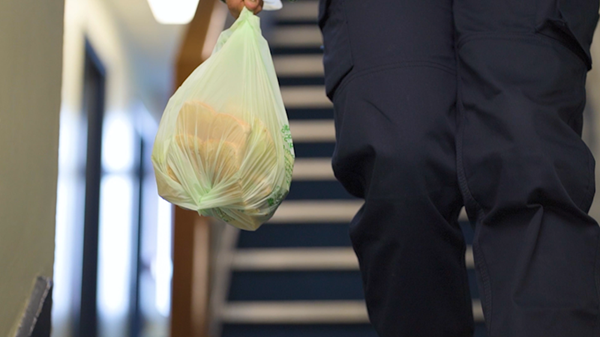
Unfortunately, not all households are ideally placed for food waste collection. Flats above shops (FLASH), for instance, are one such location where collection is challenging. Minimal space on the pavement (coupled with high levels of foot traffic), makes the use of larger bins difficult or impractical in these locations. The flats themselves, often small or with multiple occupants, still generate a substantial amount of food waste, but limited space or infrastructure for recycling means it usually ends up being disposed of incorrectly.
In some cases, councils have provided stickers on the ground for FLASH properties, where bin bags can be left close to the street for pickup, but this solution is not optimal. Leaving the rubbish wide out in the open can contribute to a range of environmental health problems, and to avoid these developing, waste collectors must attend regularly (sometimes daily) to collect the food waste. Naturally, this proves an expensive undertaking for cash-strapped local authorities and can have knock-on effects for logistics and staffing.
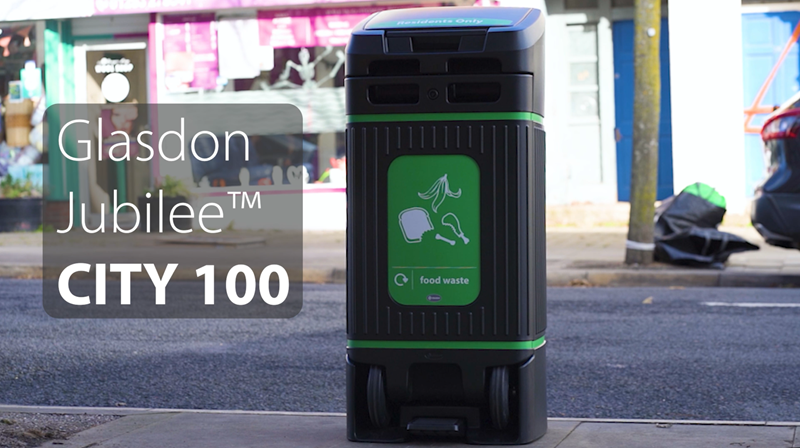
Previously, there were no dedicated solutions for collecting food waste from FLASH properties, and councils have had to make do with what was available to them. Now, our new specialist recycling bin - Glasdon Jubilee City™ 100 - provides a unique, first-of-its-kind approach to food waste collection for FLASH and other properties.
Compact & Integrated Food Waste Collection Solution
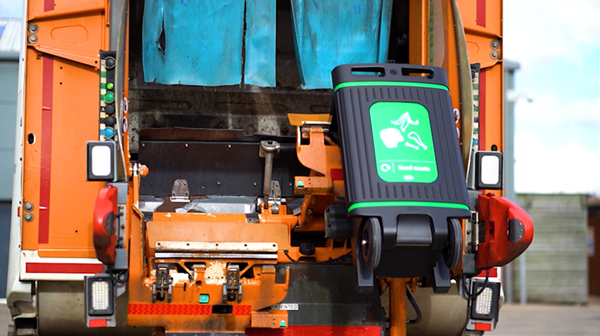
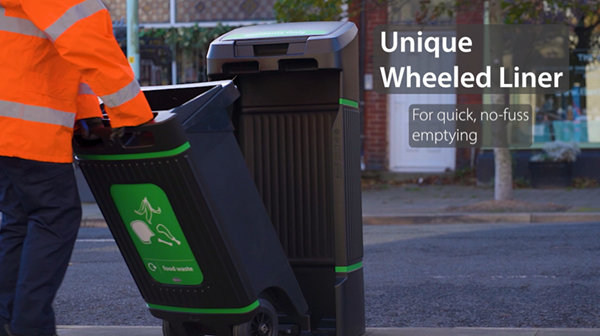
Glasdon Jubilee City 100 is a food waste recycling unit designed for easy collection by waste management teams. Its wheeled liner can be detached from the bin and wheeled over to a refuse collection vehicle for mechanical lifting and emptying of the liner. This avoids strenuous manual lifting by waste collectors and ensures quicker emptying that will keep collection schedules punctual and efficient.
Additionally, the bin’s compact footprint allows it to easily fit in constrained spaces, such as busy city streets or narrow pavements. This makes the unit ideal for HMOs, flats, and urban housing, where population density is high and ground space is limited.
Key Benefits
◊ Wheeled Liner
Easy to manoeuvre. Can be emptied via a refuse collection vehicle.
◊ 100L Capacity
Serves a minimum of 15 households based on a weekly collection.
◊ Compact
Minimal obstruction to pedestrians and residents.
◊ Slam Lock
Easily slotted back into place once emptied.
◊ Aperture Flap
Simple disposal of food waste. Can be operated hands-free with a foot pedal.
◊ BS EN 840 Standard
Tested to the critical elements of BS EN 840-5.
◊ External Ballast Base
No need for groundwork. Provides stability on any surface.
◊ Sloped Aperture
Prevents litter being left on the top surface and prevents rain pooling.
◊ Durapol® Body & Liner
Weather and vandal resistant, requires minimal maintenance, and recyclable after service life. Includes 15% recycled content.
Personalisation and graphics options are also available. Units available with or without a foot pedal.
Discover Glasdon Jubilee City 100
Watch our Product Launch Video to see Glasdon Jubilee City 100 in action.
Watch our Vandal Testing Video to see how the bin performs under duress.
For more information about the Glasdon Jubilee City 100, or to request a quote, please reach out to our knowledgeable team who will be more than happy to assist you.