 Express Products
Our partnership with ReLondon explored new, more efficient ways to collect food waste for FLASH properties.

ReLondon is a unique collaboration between the Mayor of London and London’s 33 boroughs to improve waste and resource management in the capital. The organisation’s goal is to accelerate London’s transition to a low carbon circular city by helping the city waste less and reuse, repair, share, and recycle more.
As part of their remit, ReLondon pilot new and innovative recycling solutions, which (if successful) are fast-tracked for implementation by local and national governments. One such pilot involved the use of our Nexus® City 35 Food Waste bins to help develop better food waste collections for areas where ground space is limited, such as flats above shops.
The Pilot
Flats above shops (FLASH properties) have long been troublesome for local authorities when it comes to waste collection. Most such properties only have a street-facing door, with little to no room for bins or waste stores outside. Instead, this space is filled by busy pavements, parking spaces, or entrances to businesses, with plenty of pedestrians and cars coming and going throughout the day.
Naturally, storing and collecting waste in these confined spaces poses a significant challenge to councils, and none more so than food waste collection. While plastics and metals can be left on the street in bin bags without much fuss, organic material will quickly start to rot, creating offensive smells and even attracting rodents. This can cause environmental health issues, and makes walking along the street unpleasant for both residents and passers-by alike.
With Simpler Recycling mandating the collection of food waste for all properties in April 2026, ReLondon launched a two-year pilot with the aim of providing a solution to this recurring problem. The trial ran in partnership with three London boroughs - Hammersmith and Fulham, Islington, and Waltham Forest - and involved using our Nexus City 35 Food Waste bins and placing them in strategic locations outside FLASH properties. In this way, they would act as communal food waste bins for the properties, allowing residents to dispose of their food waste in one combined unit which was easier for waste operators to collect.
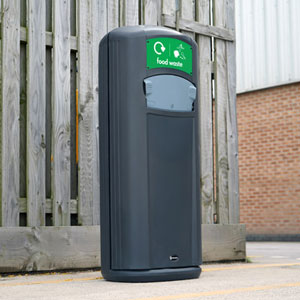
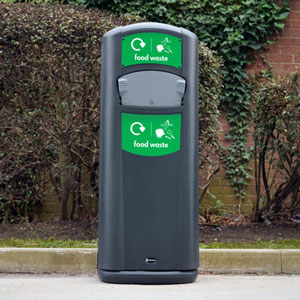
The choice to use Nexus City 35 was an important one. Not only does the bin’s compact footprint allow it to fit less intrusively on city high streets, where many FLASH properties are located, but its flap aperture prevents unpleasant odours from escaping, and provides a physical barrier to keep rodents out. Hence, the bins provided a cleaner and healthier disposal method compared to leaving organic waste out on the pavement in bin bags. The trial also made use of repurposed Slimline™ Grit Bins for residents to deposit their dry mixed recycling inside, also located on pavements.
The results of the pilot were broadly positive, with ReLondon indicating particular success in areas where residents were already engaged in recycling. The report recommended a multi-faceted approach for FLASH properties, noting that with good communication practices and operational support, recycling participation by residents rose to levels in line with WRAP’s communal collection benchmarks. However, it also noted that collection remained challenging for FLASH properties, often requiring a bespoke approach for every neighbourhood and/or street.
Read the full report from ReLondon
ReLondon’s project earned much acclaim for its detailed exploration of the challenges of implementing food waste recycling for FLASH properties. At the MRW National Recycling Awards 2025, the project won in the category of Food Waste Initiative, defeating strong challenges from other local government projects. It was also shortlisted as a finalist for both the LetsRecycle Awards of Excellence 2025 for Best Local Authority Recycling Initiative, and the LARAC 2025 Celebration Awards for Best New Idea.
Further Learnings & Innovation
As a result of our collaboration with ReLondon, Glasdon acquired useful insights that informed the design of our recently released Glasdon Jubilee™ City 100, which was still in development at the time.
While Nexus City 35 featured a metal liner that required manual emptying, Glasdon Jubilee City 100 improved on this by offering a wheeled liner that can be detached from the bin, wheeled to a refuse collection vehicle, and emptied via mechanical lifting. This reduces manual strain for the operators, and improves the speed and efficiency of waste collections. Once emptied, the wheeled liner can then be slam-locked back into place, without any unnecessary complications.
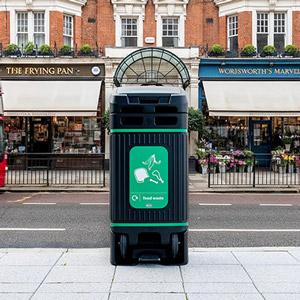
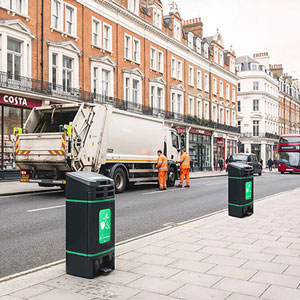
Glasdon Jubilee City 100 also offers a much larger capacity than the Nexus City 35, while still maintaining the compact footprint that allows for placement in tight city streets. Its 100L capacity, compared to 35L for the Nexus City 35, allows the new bin to serve a minimum of 15 households based on a weekly collection, making it ideal for dense apartment buildings and FLASH properties.
Learn More About Glasdon Jubilee City 100
To discover how we can help you with recycling initiatives for FLASH or urban properties, please feel free to contact us.