 Express Products
6 steps to ensure your recycling scheme is a success.
Setting up a new recycling scheme for your business (or upgrading an old one) may seem daunting at first, but the benefits of recycling should not be ignored.
Not only can your organisation save money in the long run, but a well-organised scheme can motivate employees, improve sustainability culture, and help transition your workplace towards a more circular economy.
So, what are the important steps that you need to take?
1) Complete a Waste Audit2) Hire a Waste Collection and Disposal Company
3) Select your Waste Streams
4) Choose your Recycling Bins
5) Communicate with Staff
6) Monitor
Need Help with Your Recycling Programme?
1) Complete a Waste Audit
Before trying to iron down the details of your recycling scheme, you should first complete a waste audit.
A waste audit lets you investigate the current lay of the land when it comes to waste management, allowing you to identify what types of waste your premises generates and how much. This, in turn, will make it much easier to see potential areas for improvement, and will help when adapting your workplace to the new scheme.
When carrying out a waste audit, these are some questions you might consider asking:
- How many bins do we already have?
- Does everyone have easy and convenient access to a bin?
- How much waste is collected in one week or one month?
- What types of waste are collected?
- Do our bins often overflow?
- Do our existing recycling bins have clearly labelled waste streams?
- How much contamination is happening?
Answering these questions will help inform your next steps, and make it easier to spot problem areas that need to be addressed. Hopefully, your findings will provide a good framework for your recycling scheme to develop around.
Glasdon offers a free waste audit, which you can request here.
At this stage in the process, something that often can be overlooked is the principle of Reduce, Reuse, Recycle. Before jumping into the weeds with a recycling scheme, first look to see where waste generation can be avoided instead.
If your workplace is primarily office-based, going paperless or reducing your printing habits will help reduce the amount of paper waste you produce. As for kitchens and canteens, replacing disposable cups with reusable containers or plastic cutlery with their metal counterparts are both great ways to avoid generating waste.
Sometimes, the easiest reductions in waste come from simple habit changes and adjustments. It’s important to consider this, and to look at which parts of your organisation’s waste can be reduced or reused before you turn to recycling.

2) Hire a Waste Collection and Disposal Company
Businesses and organisations have a legal duty of care to ensure their waste and recycling is disposed of responsibly.
In practice, this means hiring a suitable waste collection and disposal company to deal with your generated waste.
The company you choose should have a waste carriers license - be sure to check this license before entering into an agreement with a contracting company. DEFRA’s Register of Waste Carriers, Brokers and Dealers is a useful way of checking if a contractor has a waste carrier licence.
A licence isn’t the only element to consider when choosing a waste collection and disposal company. You may also want to consider what company is right for you. National providers usually offer more robust systems for routine waste collection and compliance tracking, which can be useful for larger organisations that produce a regular, predictable amount of waste.
However, if your business is smaller or generates less waste, then local providers might be the better option. They are often found in local directories and tend to be more flexible and knowledgeable about the local area, which can be handy for more sporadic or ad hoc pickups.
Finally, if your business generates any specialist type of waste, such as hazardous/clinical waste, WEEE (electronics), or confidential shredding, then a specialist collection company may be required for safe and responsible disposal. Often, you will need to use specialists in conjunction with other, generalist waste disposal companies to ensure your business’s waste management needs are met.
Here is a list of possible questions and considerations you may decide to ask your new or existing waste contractor:
◊ Type
- What can and can't be recycled with you?
- Will an additional fee be levied if cross contamination occurs?
- Will I get a rebate for providing quality recyclable waste?
- What types of recyclables will I get a rebate for and in what condition?
◊ Collections
- How frequent are collections?
- How are missed collections reported?
- Are there any height or weight restrictions to consider?
- Is there a charge for overfilled recycling bins?
- How do you track waste collections for compliance?
◊ Extras
- When are charges reviewed?
- Can I terminate the contract if I'm not happy with the service or if a price increase occurs?
- How and when can services be amended?
3) Select your Waste Streams
From your waste audit, you should have a good idea of what types of waste your organisation needs to collect. Now it’s time to decide on your waste streams.
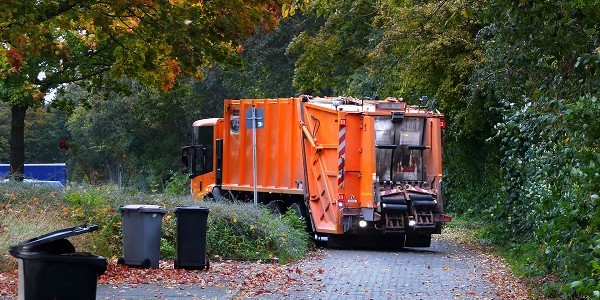
For waste materials that businesses generate most frequently e.g. paper or food waste, we advise a separate, single stream bin* for each waste stream. This will allow enough capacity in each individual bin to prevent overflowing or contamination if regular collections are made. For smaller recyclable amounts, you can combine multiple waste streams in one multi-stream container for convenience and ease of collection. Choose this option if you generate small amounts of various waste materials.
*Simpler Recycling for England, introduced in March 2025, requires business and non-residential properties by law to regularly collect six waste streams: paper/card, glass, metal, plastic, food waste, and general waste. This requires a minimum of four waste streams, with glass, metal, and plastic often combined into one ‘dry mixed recycling’ stream. Some operators may also choose to collect paper and card alongside the dry recyclables, meaning only three bins would be needed.
Similar legislation is also established in Wales and Scotland. Generally, it’s always best to check waste stream collections with your chosen waste collector, as some providers offer different recycling services and collections to others.
4) Choose your Recycling Bins
With such a range of products on the market, each with different sizes, colours, styles, materials, and streams available, it can be difficult to know which recycling bin is right for your premises.
Once you go back to your waste audit and consult your findings, you might actually find the decision comes easier than expected. Selecting the right recycling bins usually boils down to four main considerations:
◊ Placement
Being smart with where you place your recycling bins is almost as important as deciding what and how you should recycle.
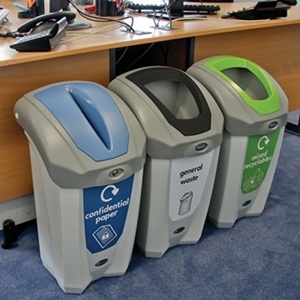
Convenience is the key. Recycling bins should be placed in central, high traffic areas where employees congregate and generate lots of waste. That might mean breakout areas, kitchens, staff rooms, canteens, entryways, corridors, or even staircases – anywhere that acts as a major thoroughfare or a transition zone. Generally, you need one standard size recycling station (160L) for every 30-50 people using the space. Staff passing by will dispose of their waste in conveniently placed bins, and as time passes, many employees will pick up regular waste disposal as a habit.
Of course, places where employees spend long periods of time, whether it be an office desk or a workshop floor, also need recycling coverage. Convenience, again, is important. We recommend placing recycling bins no more than 10-15 steps away from any given employee. Any further than that, and it risks recycling becoming too inconvenient for that employee, which could harm participation in your scheme..
Another consideration should be exterior recycling bins. You will not only need commercial wheelie bins to allow your waste collection company to make pick-ups, but you also need to consider outdoor recycling bins. If your site has multiple buildings or an outdoor area like a car park or seating area, an exterior recycling station may be needed to ensure waste doesn’t end up littering your premises and damaging the appearance of your brand.
◊ Capacity
Depending on the findings of your waste audit, you should have a reasonable idea of what capacity bins you will need. Knowing where you intend to place a recycling container, who you intend the users to be, and what recyclable waste you intend to collect will all help in determining the right capacity for an area.
For example, if an office-based workplace generates a high volume of coffee cup waste, but few other recyclables, you may choose to get a dedicated indoor coffee cup recycling bin alongside a 30-litre mixed recyclables bin. This would provide adequate capacity for both the cups and other types of recyclables.
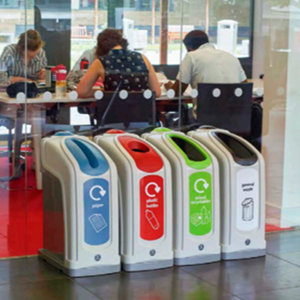
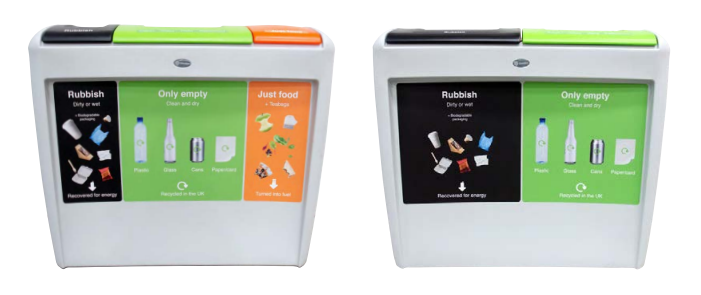
Or, if your company generates a moderate amount of waste for a few different materials, you may opt for a quad recycling station with four 40-litre waste streams in one unit. This cuts the cost of buying multiple bins, while providing the necessary capacity to collect multiple waste streams.
A school, warehouse, retail company, or any other business with high indoor and outdoor traffic may place several large-capacity recycling bins outside and some additional smaller bins indoors. This widespread coverage will provide enough capacity for both indoor and outdoor waste collection.
Once you’ve landed on what capacity you’ll need, finding the right size recycling container should be quite easy. There’s a huge range of different bins to choose from, from 2.5-litre desktop recycling units to 1280-litre lockable wheelie bin storage. If in doubt, opt for a larger capacity bin, as this will reduce the likelihood of overfilling and contamination.
For help with choosing a recycling bin, read our guide.
◊ Apertures
A bin’s aperture (opening) is often overlooked but can play a pivotal role in the success of your recycling scheme.
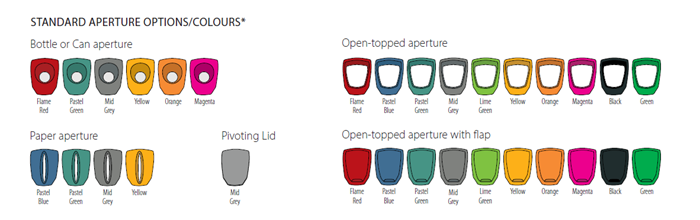
Reduced-size apertures (e.g. slot, round, or oval-shaped) are openings that are suited to specific waste streams. They encourage staff to place appropriate waste into the correct bin, and act as a barrier to incorrect waste. This way, they provide a natural defence against cross-contamination and minimise the possibility of your waste collectors rejecting or charging you for contaminated waste.
Apertures come in various colours, which make them easy to spot and allow them to coordinate with signage to improve recycling rates. Some recycling units with multiple waste streams offer the ability to use different apertures for different waste streams, which can be particularly helpful for reducing contamination.
◊ Visibility
Closely tied to placement, the visibility of your recycling bins must be strong to ensure good participation rates. Even if your employees know how or where to recycle, visitors or new starters to your organisation won’t, so it’s essential to keep your bins and signage easily discernible. Avoid placing recycling bins around corners, or tucking them away in empty alcoves - keep them in central locations instead to draw attention.
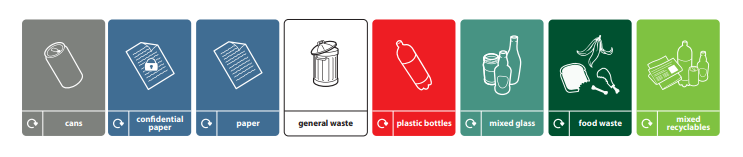
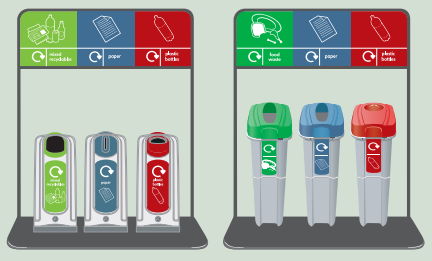
Using graphics and signage will not only allow for easy identification of recycling points, but it will also help inform users where to dispose of each type of waste. WRAP recycling graphics are ideal for this, as they are bold, clear, colour-coded, and universally recognised across the UK. The right images and graphics will make recycling feel like second nature, even to those on-site for the very first time.
To highlight the sustainability goals of your business, you may also want to personalise your recycling bin graphics to incorporate your organisation’s logo or branding. Whether it be a company crest or a full graphic wraparound, the aesthetics of your recycling bins can often be tailored to fit workplace branding, corporate colour schemes, or government schemes.
Read more about personalisation and branding.
5) Communicate with Staff
Once the foundations of your recycling scheme have been set, it’s important to communicate the new changes to your staff. While this may sound straightforward, it can actually be one of the most difficult parts of setting up a new scheme.
Company-wide comms, whether it be through a meeting, email, posters, intranet notices, or preferably all of the above, are essential to getting buy-in from your staff. Make sure to include details of what is changing, why, what is expected of employees, and any environmental targets that you’re aiming for. Keep the topic open for discussion as well – receiving feedback and suggestions from your staff can be a great way to iron out any uncertainty and ensure your scheme is implemented as smoothly as possible.
It may also be worth appointing a green ‘champion’ to lead the way. This could be an employee that is passionate about recycling, or a senior colleague that has been heavily involved in the planning process. It could even be a team of champions, or one per department. Their purpose is not to badger everyone else or try to keep them ‘in line’, but rather to set an example and be an advocate for the new scheme. It might even make sense for them to run quick sessions with staff to train them on the new recycling programme.
Simple, clear signage also plays a role in this transition. Try to keep the signage as straightforward as possible on the recycling bins themselves, while nearby posters and fact sheets can be used to educate your staff. Recycling facts, statistics, motivational quotes, or cost-benefit examples can motivate your employees and allow them to take ownership of the scheme, boosting participation.
Communication should not be limited to your regular workforce, either. Discuss with your cleaning staff about how frequently recycling bins are emptied, and be sure to include them in the process throughout.
6) Monitor
Your scheme is set up, your recycling bins have been chosen, and your staff have been communicated to. Now, the best way to measure the success of your brand-new recycling scheme is to monitor it.
You may want to conduct another waste audit with the same questions as before, perhaps several months after implementation to give your staff time to adjust. How much waste are you collecting now? Is any of it contaminated? Are employees regularly using the scheme or has it flown a bit under the radar? Answering these questions will help you point out any emerging problems, and determine what improvements have been successful and what haven’t. Use these findings to adapt your scheme accordingly.
Performing scheduled reviews and spot checks can also help keep track of whether your employees are segregating waste correctly. Be open and transparent about this – seek feedback and set goals rather than trying to catch employees out. Any lapses may indicate further training or communication is needed to fully engage staff with your environmental objectives.

Need Help with Your Recycling Programme?
As the UK strives towards its goal of eliminating avoidable waste, recycling will take centre stage in the fight for a greener, more sustainable future. As workplaces and businesses, we all have a role in preserving the planet for future generations, and we must all work to reduce the amount of waste sent to landfill. So what changes will your workplace make to pursue environmental targets?
If you’re struggling to get started with your recycling programme, let’s have a look together. Reach out to us for a free waste audit, explore our extensive range of recycling bins and containers, or contact us with your enquiry.
Whether you’re aiming to comply with legislation, reduce waste disposal costs, or hit your environmental goals, we look forward to helping your organisation build a better future.
Our full Guide to a Successful Recycling Programme is available to download as a pdf below.
Divided into two sections - Recycling for a Greener Future & The Practical Guide to Creating a Successful Recycling Programme - the guide covers the reasons for recycling, the advantages of a recycling programme, and a step-by-step guide of how to create a successful and cost-effective scheme.
Find out how to:
- Identify and manage specific waste streams
- Recognise what can be recycled (and what can’t)
- Create a successful recycling programme for your workplace or organisation
- Unlock the financial and business benefits of recycling