 Express Products
Depending on the nature of your business, and what country it is located in, different waste streams will need to be considered.
What is a Waste Stream?
A waste stream is a specific flow of waste, from source to disposal to recycling. How an item is treated, recycled, and its hazard level will all contribute to determining its waste stream.
Common waste streams include:
- General Waste
- Organic/Food Waste
- Paper & Card
- Plastic
- Metal
- Glass
Many waste collectors choose to collect certain types of recyclables together in the same waste stream, which is known as co-mingled recycling. For instance - plastic, metal and glass items are often combined into a ‘dry mixed recycling’ waste stream as they are easy to separate afterwards. However, the rate of wastage for co-mingled recycling can be higher, as it's easier for users to accidentally contaminate the recycling.
Some waste streams cannot be co-mingled, such as food waste and general waste. Food waste tends to be mushy and rots quickly, making it difficult to separate from other recyclables and leading most waste collectors to require food waste as a separate waste stream. General waste (otherwise known as residual waste) is only for non-recyclable items, and also requires a separate waste stream.
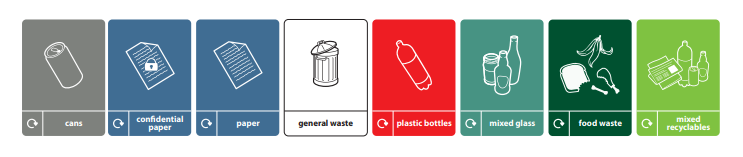
Other, more niche waste streams have unique properties, and may require specialist collection:
- Batteries
- Textiles
- Vapes
- Coffee Pods
- Crisp Packets
- Electricals/Electronics
- Hazardous/Clinical Waste
Many businesses won’t generate significant amounts of these types of waste, but if your organisation does, it’s a good idea to accommodate these waste streams in your recycling scheme.
How Many Waste Streams Do I Need?
Selecting your waste streams depends primarily on two things – national legislation and business needs.
◊ Legislation
In England, Simpler Recycling legislation was introduced in 2025 which mandates the collection of six waste streams as standard. This includes general waste, food waste, paper & card, and dry mixed recycling.
Organisations with more than ten employees are required to adopt the new waste streams, but ‘micro-firms’ with ten or fewer employees have a slight extension until 31st March 2027 to comply with the changes.
If your business is in England and is bound by these changes, you will need to collect the above six mandatory waste streams at a minimum.
In Wales, Workplace Recycling Regulations were introduced in 2024 to ensure the following materials are recycled and collected:
- Food Waste (if producing more than 5kg a week)
- Paper & Card
- Glass
- Metal, Plastic, Cartons & other Fibre-Plastic Based Packaging
- Unsold small electrical and electronic equipment (SWEEE)
- Unsold textiles
All workplaces, including businesses, public sector organisations, and charities must comply with the regulations. The only exception are NHS and private hospitals, which were given an extension of two years to 2026 to comply with the legislation.
If your premises is in Wales and produces any of the above types of waste, you will need to include these waste streams in your recycling scheme.
In Scotland, businesses are bound by the Waste (Scotland) Regulations 2012, which mandates the recycling of Glass, Metal, Plastic, Paper, and Cardboard.
Additionally, food businesses that produce over 5kg in food waste a week, such as cafes, restaurants, and takeaways, must also present food waste for collection. Some rural businesses are exempt from this rule, as well as businesses that only prepare and sell drinks (such as bars or nightclubs). Otherwise, all premises involved in the processing, distribution, preparation, or sale of food must comply, including staff canteens.
If your organisation resides in Scotland, you must comply with the above rules and ensure you collect the required waste streams.
◊ Business Needs
In addition to any legal waste responsibilities, you should also determine any practical considerations. For instance, does your business need to collect any additional and/or specialist waste streams?
If you haven’t already, conduct a waste audit to learn what types of waste your site generates the most of. For the average office workplace, your employees will generate a moderate amount of food waste, paper & cardboard waste, plastic bottles, metal cans, and general waste every day. A café, on the other hand, may produce larger volumes of food waste and disposable cups. A workplace that utilises lots of technology may generate battery and electrical waste, whereas hospitals will need to safely dispose of clinical waste.
Point being, there’s a whole array of different possible types of waste, meaning the recycling bins that you choose should be configured to capture as much recyclable material that is relevant to your business as possible. Make sure to confer with your waste disposal company to learn which waste streams they accept, and which ones they don’t. In some cases, two or more disposal companies may need to be contracted to ensure every waste stream is adequately collected.
Single Stream or Multi-Stream Recycling Bins?
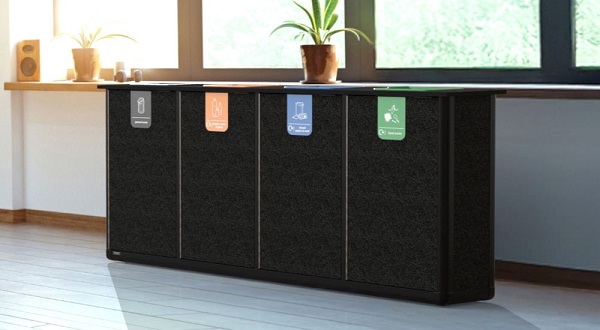
Recycling bins exist in two broad categories – those that accept a single waste stream, and those that are divided to take multiple waste streams. Single stream bins offer a sizeable capacity, but will need to be placed one next the other to cover each waste stream, whereas a combined unit can provide multiple waste streams and save floor space, albeit with lower overall capacity.
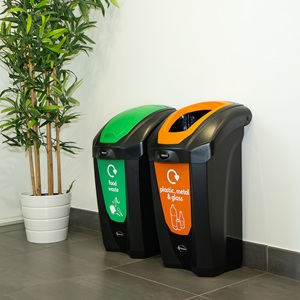
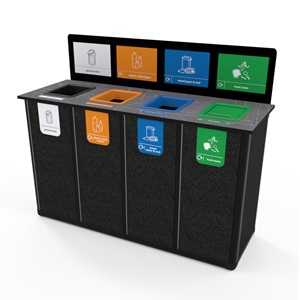
Often, the choice between the two will depend on your intended placement. If you’re looking for units for offices and workplaces, it’s likely you may have a greater need for paper recycling and mixed recyclables, whereas for canteens, containers for food waste, plastic bottles and cans will be more necessary. It’s important to provide a waste stream for general waste alongside your recycling waste streams, as this helps prevent contamination.
Assuming your recycling bins are emptied on a daily basis, then one multi-stream recycling container will usually be enough for smaller areas such as meeting rooms or side offices. For busier areas such as corridors and entranceways, you’re likely looking at a recycling hub comprised of several single stream bins.
If you know your business generates one type of waste much more than others, such as food waste in a canteen, consider placing one single stream bin next to a multi-stream bin. The single stream container will offer a higher capacity for the large volume waste stream, whereas the multi-stream bin will cover the smaller volumes of other waste.
How Glasdon Can Help
Our purpose-designed recycling bins and recycling stations are ideal for the segregation of a wide range of recyclable waste streams including plastic bottles, glass, batteries, confidential paper, food waste, mixed recyclables, cans and paper.
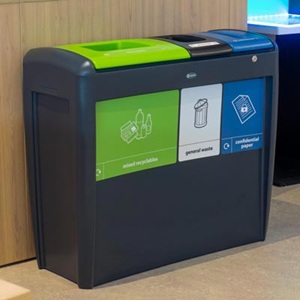
To suit the requirements of your recycling programme, we offer multi-stream recycling bins with individual compartments and specially moulded apertures to allow for the collection of multiple types of waste in one compact unit. The Nexus® Evolution Recycling Bin, for example, is a 160-litre container that can be purchased as a duo, trio or quadruple compartment model. For areas where floor or cupboard space may be limited, we also offer stackable recycling bins. Our guide on how to choose stackable recycling bins is available to help you select the ideal solution for your environment.
Many of our recycling bins, such as our Nexus® 50 or Nexus® 100 ranges, also come with kits to connect them together to create one neat and tidy recycling station.
If you see the container you need but it's not in the desired waste stream, we will be more than happy to personalise your choice of recycling bin to suit your needs.